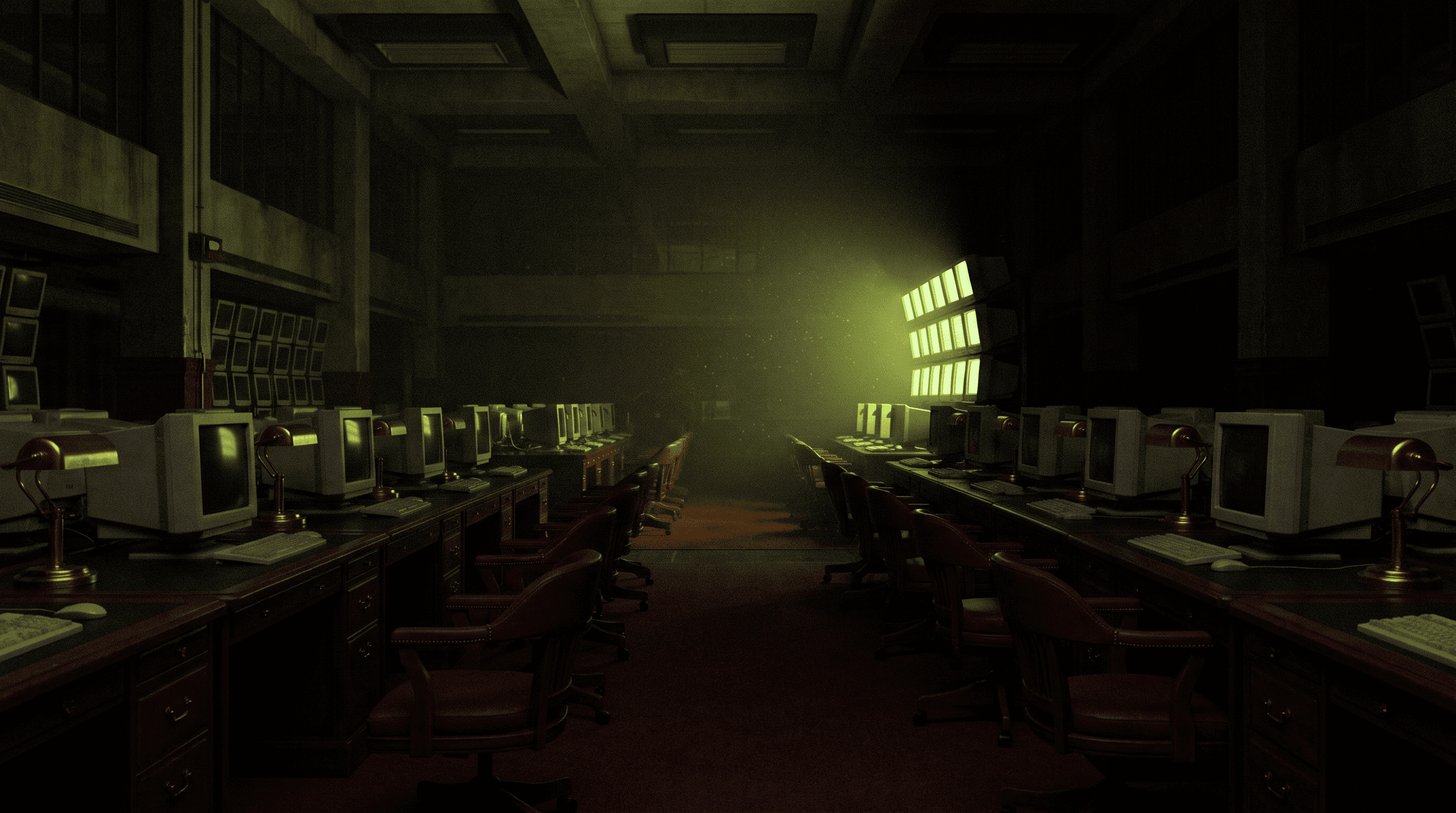
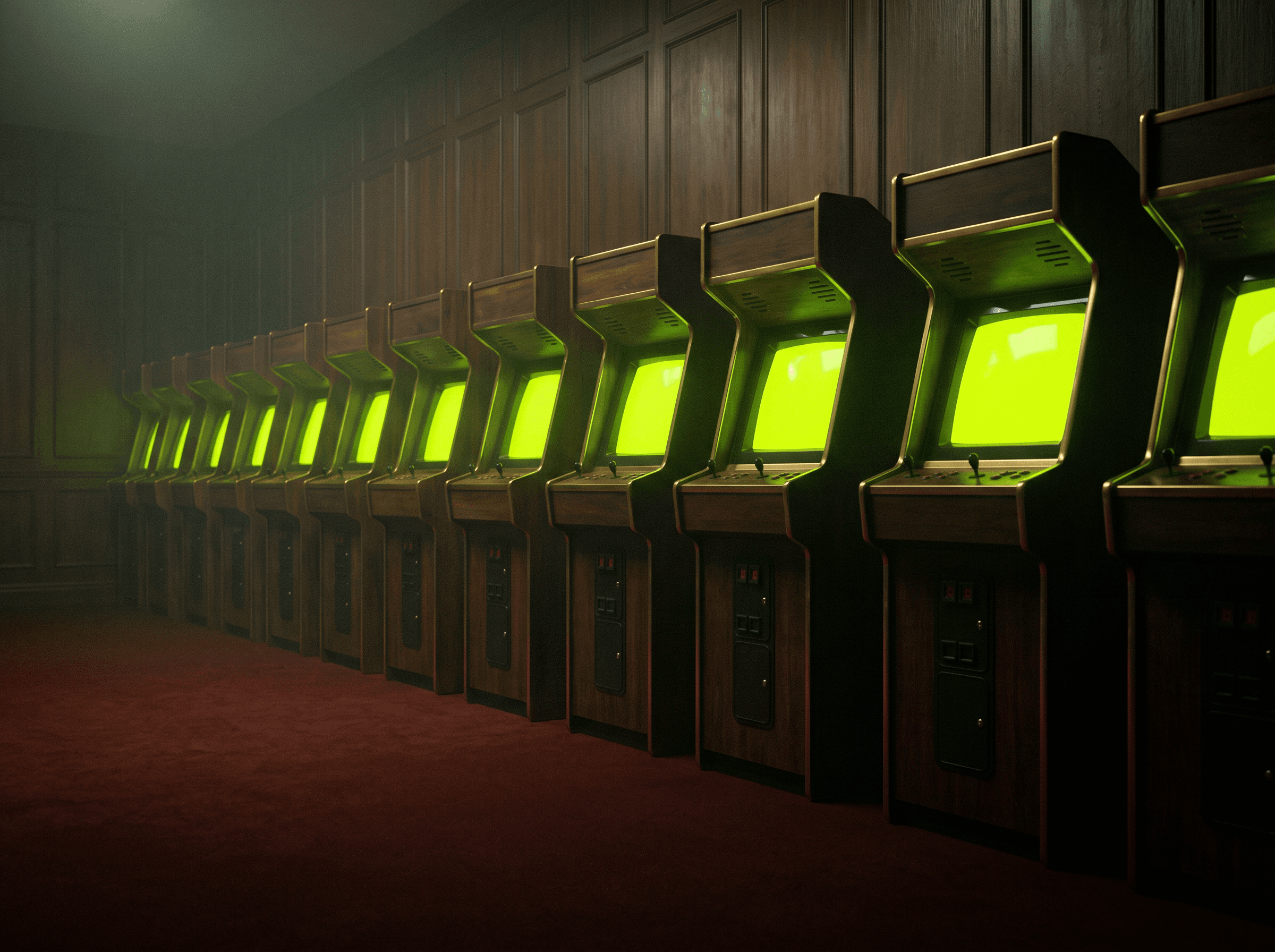
The Trading Floor
Coinflip. Pick a side.
Fair 50/50 from the seed chain. A win pays 1.90 minus your floor. Fastest possible first play: under ten seconds, no wallet, no signup.
The teaching machine. It exists to make the dial obvious in one play.

The coin decides if you win. The market decides what it's worth.
Every machine in this building has a dial. Turn it up and a loss still pays you real tokenized stock. Turn it down and the win climbs to 1.90×. The house edge never moves off 5% at any setting, and the formula is printed on the cabinet.
A model, not a live market. Prices shown are illustrative and no money moves here. Every machine carries a 5% house edge — over enough plays the expected outcome is a loss.
You put money in. You win, or it is gone. That is why most first-time players never place a second bet.
The prize is only worth what the house's own chart says on the day you try to leave.
Reserve protocols price a stablecoin-backed token at many times its backing. Anyone arriving late buys the premium, not the backing.
Emissions, rebases, backing ratios. A product that needs a prospectus has already lost the room.
No artifact, no discovery. Acquisition is paid and retention is a headline number.
People will accept a smaller win in exchange for not being wiped out — in enormous numbers, if the consolation is something they wanted to own anyway.
TBA — the address appears here at launchAlways verify against the official channels below. Fake addresses are posted constantly.

Coinflip. Pick a side.
Fair 50/50 from the seed chain. A win pays 1.90 minus your floor. Fastest possible first play: under ten seconds, no wallet, no signup.
The teaching machine. It exists to make the dial obvious in one play.
Crash. Pick the floor you step off at.
The car keeps climbing until it doesn't. Win chance follows p = (0.95 − f) / (T − f), so the floor is paid for with probability, never with edge.
Built for the clip. The number climbing is the most postable three seconds in the building.
Boxed packs in 1996 shrinkwrap. Odds printed on the back of the box and posted on chain. A floor on every box.
A nightly draw funded from collected rake, never from player deposits.
A career run where every promotion buys real positions into an escrowed book. Three ways out.
A two-sided pool that pays when the reference market falls, settled on posted closes.

A balance is a number, and nobody bonds with a number. A Book is a set of positions with names on them, and sets pull people back.
Stated the same way everywhere it matters: your shares are credited the second you play; deliver them to your wallet any time, free. Until delivery they are a claim, and what backs that claim is on floor 09 — in public.
The headline is a pile of losses. That is the point — self-deprecating artifacts travel further than wins, and every posted certificate carries the contract address.
It rises on its own as the house grows. No single player can drain it.
New bets stop. Existing books stay deliverable. A brake, not a panic button.
Nobody decides where the money goes. The ratio does.
One published address holding the same basket every player Book is denominated in. Anyone can open the explorer and count it — no account, no wallet, no permission. Solvency is the first question every player has, and in this category nobody answers it.

| Floor | Loss pays | Win pays | RTP |
|---|---|---|---|
| 0% full send | 0.00× | 1.90× | 95% |
| 10% | 0.10× | 1.80× | 95% |
| 20% | 0.20× | 1.70× | 95% |
| 30% default | 0.30× | 1.60× | 95% |
| 40% | 0.40× | 1.50× | 95% |
| 50% pension | 0.50× | 1.40× | 95% |
On a machine where you pick the target multiple T, the dial moves the win probability instead: p = (0.95 − f) / (T − f). You pay for the floor with probability, never with edge.
A model of the economy at launch settings, not a performance claim.
Money enters this building through exactly one opening: the 5% house edge on wagered volume. No transfer tax, no emission, no subscription, no listing fee. If nobody plays, the house makes nothing — that is the correct incentive and it is the whole design.
Early on, bankroll matters more than burn — a thin house means a small max bet, and a small max bet is a boring building. Once coverage clears 10× the machine shifts its own weight to burn. The ratio is public, so the active split is public, so the allocation is auditable by anyone with a browser.
Pay the house toll in $FLOOR and the edge drops from 5.0% to 3.5%. The tokens spent are burned outright.
96.5% return is still below 100%.
Holders unlock a wider dial, 0–60% instead of 0–50%.
W = 1.90 − f returns exactly 95% at every value of f, so a wider dial is mathematically neutral.
Cabinet skins, certificate borders, standings name plates.
100% of spend burned.
A weekly slice of rake paid out in $FLOOR to active players, weighted by plays rather than by amount wagered.
Puts tokens with people who use the building.
The honest summary, printed in the docs word for word: the token buys a cheaper toll and better-looking furniture. It does not buy luck.
roll = HMAC-SHA256(server_seed, client_seed:nonce)
The commitment is published before you arrive. The chain rotates and is revealed in full, and you control the client seed — so pre-selection is impossible. The verify page recomputes both the hash and the roll locally; no server call is part of the check.

A posted certificate brings someone in. The building draws itself.
One button, no wallet. Under ten seconds to the first result.
They drag the dial and watch the payout move. This is the hook.
"You lost. You still got 0.0021 NVDA." The line that makes it stick.
Connect, deposit, flat welcome credit. The Book becomes real.
Seven symbols, seven slots. Losses accumulate into a portfolio.
The certificate prints how many losses built the book. It gets shared.

Day-7 return rate of players who lost their first play.
If the floor works, this number is unlike anything else in the category. If it doesn't, nothing else matters.
Nobody is paying casino prizes in tokenized equities with a player-set floor on a chain where real equities already settle.
The certificate carries the contract address. Growth compounds through the artifact, not paid acquisition.
Dial-setting distribution across thousands of sessions prices every machine we build next.
A Book is a collection with your losses written into it. Balances do not do that.
Full commitment to a 1996 institutional voice, drawn in three dimensions. Half-committing looks worse than not doing it.
Public solvency, in-browser verification, formula-driven splits and self-scaling limits are hard to retrofit without explaining why they weren't there before.
I lost 26 of 47 flips this week and walked out holding 0.31 NVDA. That is the whole product.